

Changelog - June 2026
- General
Get notified when a claim fails to finalize
Enable the Finalization Failure notification to get an email whenever a claim fails to finalize, so your team can act quickly.
You can now receive an email alert whenever a claim fails to finalize. Turn on the Finalization Failure toggle in Settings > Notifications, enter the email addresses that should receive the alert, and save. This makes it easier to catch and resolve stuck claims before they affect your customers.
- Returns and Exchanges
Choose when your return window starts
Choose which order event starts your return eligibility window: order created, fulfilled, delivered, or payment processed.
You can now control which order event marks the beginning of your return window. In Returns settings, a new Return Window Start Date field lets you choose from Order Created On, Order Fulfilled On, Order Delivered On, or Payment Processed On.
This gives you flexibility to align your return policy with the moment that makes the most sense for your business, whether that is when the customer places the order, when it ships, or when it arrives.
- Returns and Exchanges
Filter return and warranty claims by inspection grade
Filter return and warranty claims by inspection grade from the claims list view in the Corso Admin.
You can now filter your return and warranty claims lists by inspection grade directly from the claims search bar. Select one or more grades to narrow the list to claims whose inspections match the grades you configure in your settings. This makes it easier to route high-priority or failed inspections to the right team members without manual sorting.
- Returns and Exchanges
Right to Withdraw for EU orders
Offer eligible EU customers the statutory 14-day cooling-off period to withdraw an order and request a refund from your customer portal.
You can now offer eligible EU customers the statutory 14-day cooling-off period directly in the customer portal.
Add a Right to Withdraw rule under Automations and the required EU country conditions come pre-applied. Customers across the 27 EU member states can then withdraw from a qualifying order and request a refund within 14 calendar days of their most recent delivery. The window automatically extends to the next working day when it falls on a weekend or public holiday, and you can customize the portal messaging that explains customers their rights.
- Platform
Manually Set Custom Parcel Dimensions
Brands using a carrier shipping account that requires parcel dimensions as part of the label generation request can now manually enter those dimensions when generating a shipment, removing a previous blocker for carriers with stricter label requirements.
- Integrations
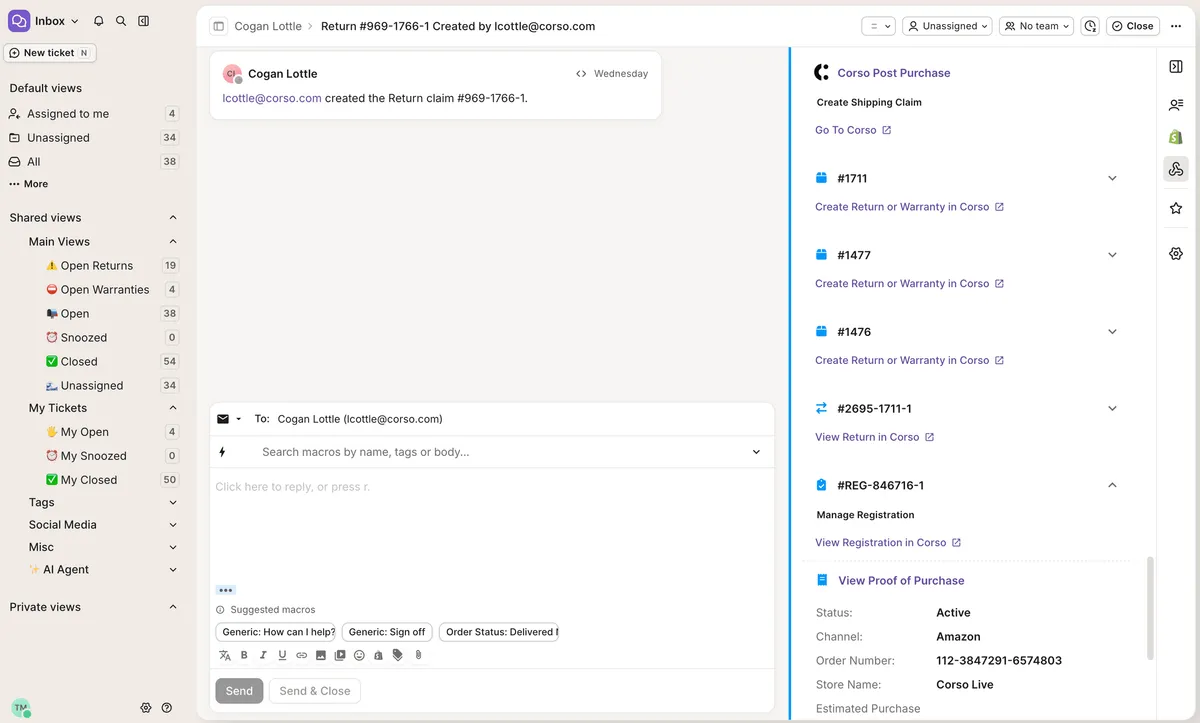
Improved Gorgias Integration Now Available
Made a number of improvements to the Gorgias integration, including automatic ticket creation in Gorgias when a claim is submitted, giving support teams a cleaner way to manage claims without leaving their helpdesk. The Corso widget inside Gorgias has also been redesigned to be simpler and easier to read, with better visibility into returns, warranties, and registrations. Additional updates include the ability to manage registrations and view proof of purchase directly in Gorgias, improved actions for creating a shipping claim from the widget, and a direct link out to claim details in the Corso admin.
- Platform
New Same Address Risk Added to Claim Risk Factors
Added a new claim risk factor that flags when the same shipping address appears across multiple claims tied to different customer accounts. This helps brands identify potentially fraudulent activity where the same address is being used under different emails to file multiple claims.
- Returns and Exchanges
Store Credit for Exchange of Exchanges Now Available
Brands can now offer store credit as a resolution option on exchange of exchange orders, rather than being limited to exchanges only. This gives brands more flexibility to configure how they handle second exchanges and offer customers a choice between the two resolution types.