

Exchanges & Revenue Retention
Exchange software that turns
refunds into revenue
Four exchange paths: Shop Now, Instant Exchanges, Advanced Exchanges, and store credit with bonus incentives. Each has configurable financial mechanics, behavioral steering, and real-time visibility into how exchange programs perform.
The Opportunity
Leverage exchanges as your highest-capability workflow.
Every return is a revenue decision, and the difference between a 20% exchange rate and a 50% exchange rate is significant. Exchange rates don't improve by adding a button. They improve when the exchange path is genuinely better for the customer.

Different paths for different scenarios
Wrong size needs a quick variant swap. Doesn't like the product needs to browse alternatives. VIP customer should get the replacement shipped immediately. One exchange type doesn't serve all three.
Visible, honest incentives
Bonus credit on store credit. Free shipping on exchanges. Fee waivers for exchange paths. The customer sees the math and makes a choice. Refunds are always available, but the steering is through making exchanges genuinely better.
Dollar-impact measurement
Exchange rates alone don't tell you enough. You need to see how much credit was issued, how much bonus was given, how much upsell was captured, and what the net retention looks like. The Returns Ledger provides this.
Shop Now
Bring the storefront into the return flow.
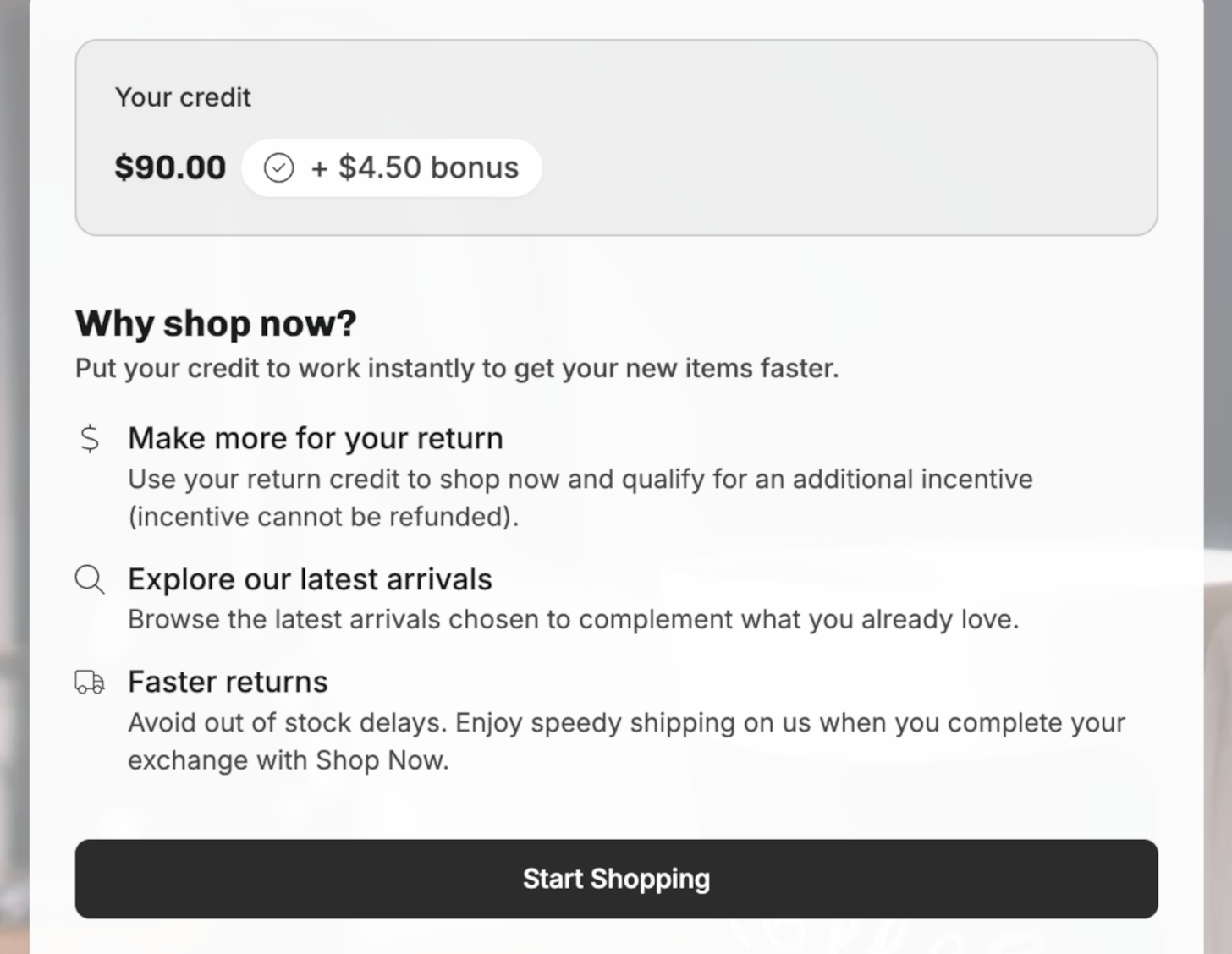
Customers browse the full storefront and shop with their return credit like a real-time gift card applied to a new purchase. Any price difference is charged or credited automatically. No constrained "exchange picker," no limited product list. Same catalog, same checkout, same brand experience customers already know. The result is an exchange path customers actually want to take instead of an obligation that ends in a refund.
Select resolution
Customer chooses "Shop for something new" during the return flow. Bonus credit amount shown upfront.
Browse storefront
Redirected to the merchant's Shopify storefront with return credit available. Full catalog access.
Price difference
New purchase costs more? Customer pays the difference. Costs less? Remaining credit issued as store credit.
Return shipment
Original item is returned via the merchant's configured shipping policy. Label or packing slip generated.
Bonus credit
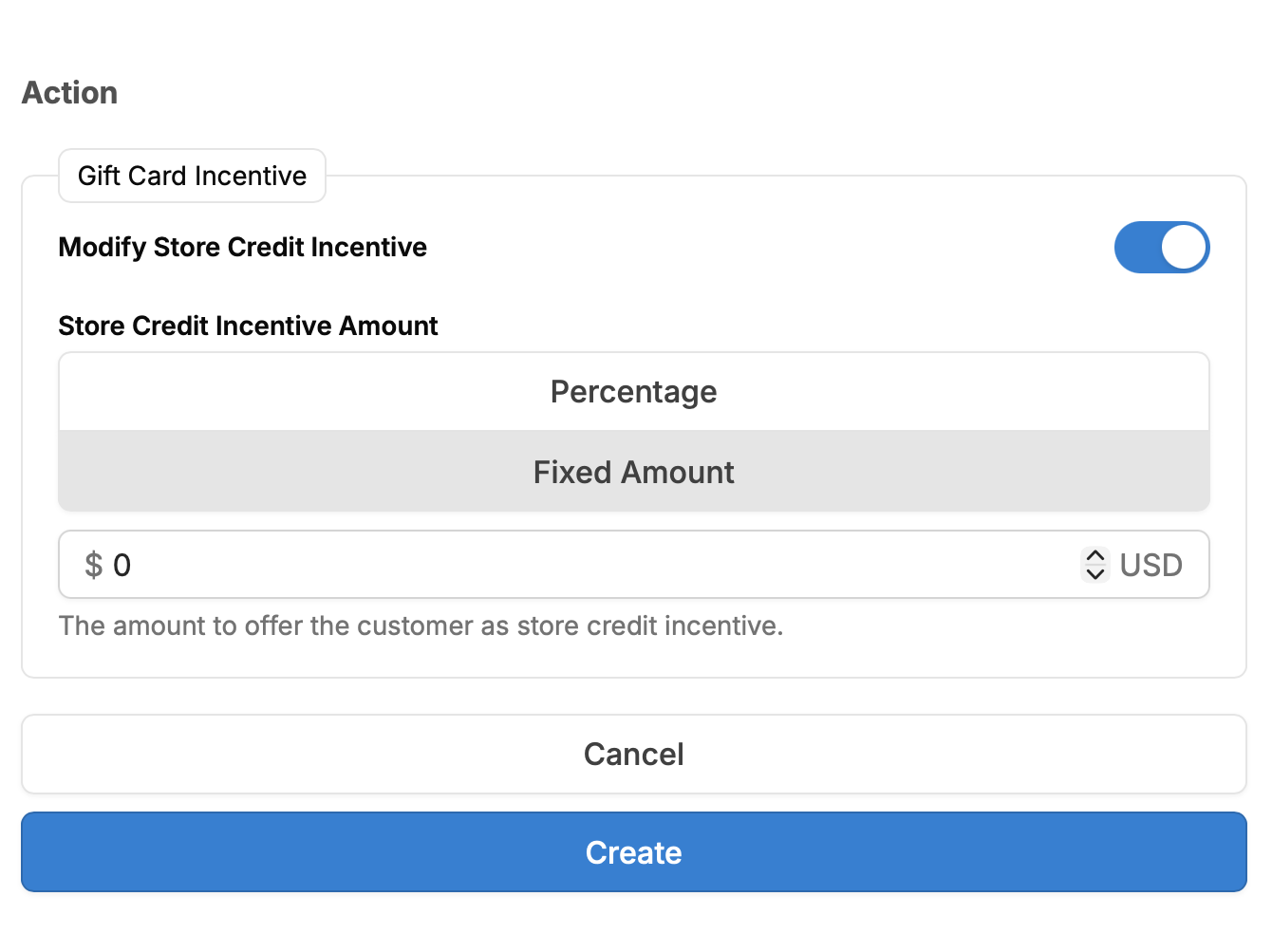
Add a fixed dollar amount or percentage to Shop Now credit. The bonus appears on the resolution-selection screen, and the customer sees exactly how much extra they're getting.
Conditional incentives
Gift Card Incentive automations vary the bonus by product, customer tag, order value, or return reason. High-margin products get a larger bonus. Loyalty-tier customers get extra. Fully configurable per rule.
Instant Exchanges
Ship the replacement before the return arrives.
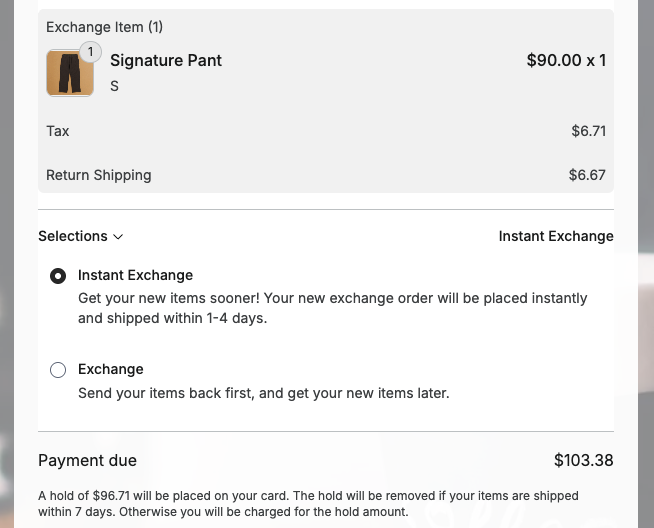
Eliminates the waiting gap. The customer gets their new product immediately. The merchant is protected by a payment pre-authorization hold.
- 1 Customer initiates exchange
- 2 Customer ships original item
- 3 Merchant receives and inspects
- 4 Merchant ships replacement
- 5 Customer receives replacement
Typical: 7–14 days without product
- 1 Customer initiates exchange
- 2 Pre-authorization hold placed
- 3 Replacement ships immediately
- 4 Customer receives in 2–3 days
- 5 Original returned at own pace
Customer has replacement in 2–3 days
Optional Instant Exchange
Customer chooses between Instant Exchange (pre-auth hold, ships now) and standard exchange (wait for processing). Both paths presented with clear explanations of tradeoffs.
Required Instant Exchange
Force Instant Exchange as the only exchange path. Simplifies the flow. Ensures fastest possible customer experience. Pre-auth hold protects the merchant regardless.
What if the customer never returns the original?
The pre-authorization hold converts to a full charge after the return window expires. The merchant is not exposed. The financial risk is fully covered. Corso's automation engine tracks hold status and triggers the conversion automatically. If the return item arrives damaged, claim inspections can evaluate before the hold is released.
Advanced Exchanges
Cross-product and variant exchanges.
Sometimes a customer just needs a different size. Sometimes they want a different product entirely. Both are handled, with automatic price-difference calculations and merchant-controlled eligibility. Variant swaps stay within the product. Cross-product exchanges reach across collections, tags, or categories. The customer sees the new price and the difference owed or refunded before they confirm.

Product Exchanges
The simplest exchange type. Variant swaps within the same product, like size medium for large or blue for green. No browsing required. Fast and straightforward.
Eligibility configured through Product Groups. Within a group, variant-level swaps are automatic.
Advanced Exchanges
Exchanges across product lines. A shirt for pants. A medium in one style for a large in a completely different style. Any product-to-product exchange where items aren't simple variant swaps.
Price differences handled automatically. Upsell charges the difference, downsell credits it back.
Upsell
Customer exchanges $40 item for $55 item
Downsell
Customer exchanges $55 item for $40 item
Even swap
Customer exchanges $50 item for $50 item
How Product Groups work
A Product Group is defined by one or more Shopify product tags, product types, or collections. Any product matching the group criteria is eligible for exchange with any other product in the same group. Groups are reusable across automation rules, eligibility rules, and exchange configurations.
All Apparel
Tag: apparel → any-to-any exchange within the tag
A customer who ordered a t-shirt can swap it for a hoodie, a dress, or any other apparel item. Maximum flexibility for catalogs where most products are interchangeable.
Same Collection
Collection: Spring 2026 → exchange within collection only
A Spring 2026 piece can only swap for another Spring 2026 item, not the Fall drop. Keeps cross-season exchanges out of next-quarter inventory and margin.
Value Tier
Price: $40–$60 → free exchange within tier; cross-tier triggers price diff
Customers swap freely inside a price band. Stepping up to a higher tier charges the difference, stepping down credits it back.
Incentives
The incentive layer that makes exchanges better.
Three levers: bonus credit, fee structures that favor exchange paths, and transparent claim summaries. All configurable, all visible to the customer. Most return programs hide the math from the shopper, so a refund becomes the path of least resistance. Showing the dollar amounts side by side flips that assumption, and the customer chooses what's actually best for them.

Exchange
Free shipping
Ships immediately
No fees
Store Credit
$50 credit + $5 bonus
Free return shipping
No fees
Refund
$50 refund
−$7.50 return shipping
Original payment method
Higher bonus on high-margin items. Lower or no bonus on already-discounted products.
Loyalty-tier customers get a bigger bonus. New customers get standard. Segment via Shopify tags.
Orders above a threshold get elevated bonus to retain the larger transaction.
"Wrong size" returns (likely to repurchase) get larger bonus. "Changed my mind" gets standard.
Claim Summary transparency: Before confirming, the customer sees an itemized breakdown: return credit amount, bonus incentive (if applicable), deductions, fees (if applicable), exchange price difference (if applicable), and the net amount. Nothing hidden. Nothing estimated. The exact financial outcome is visible before submission.
Measurement
See exactly where the money goes.
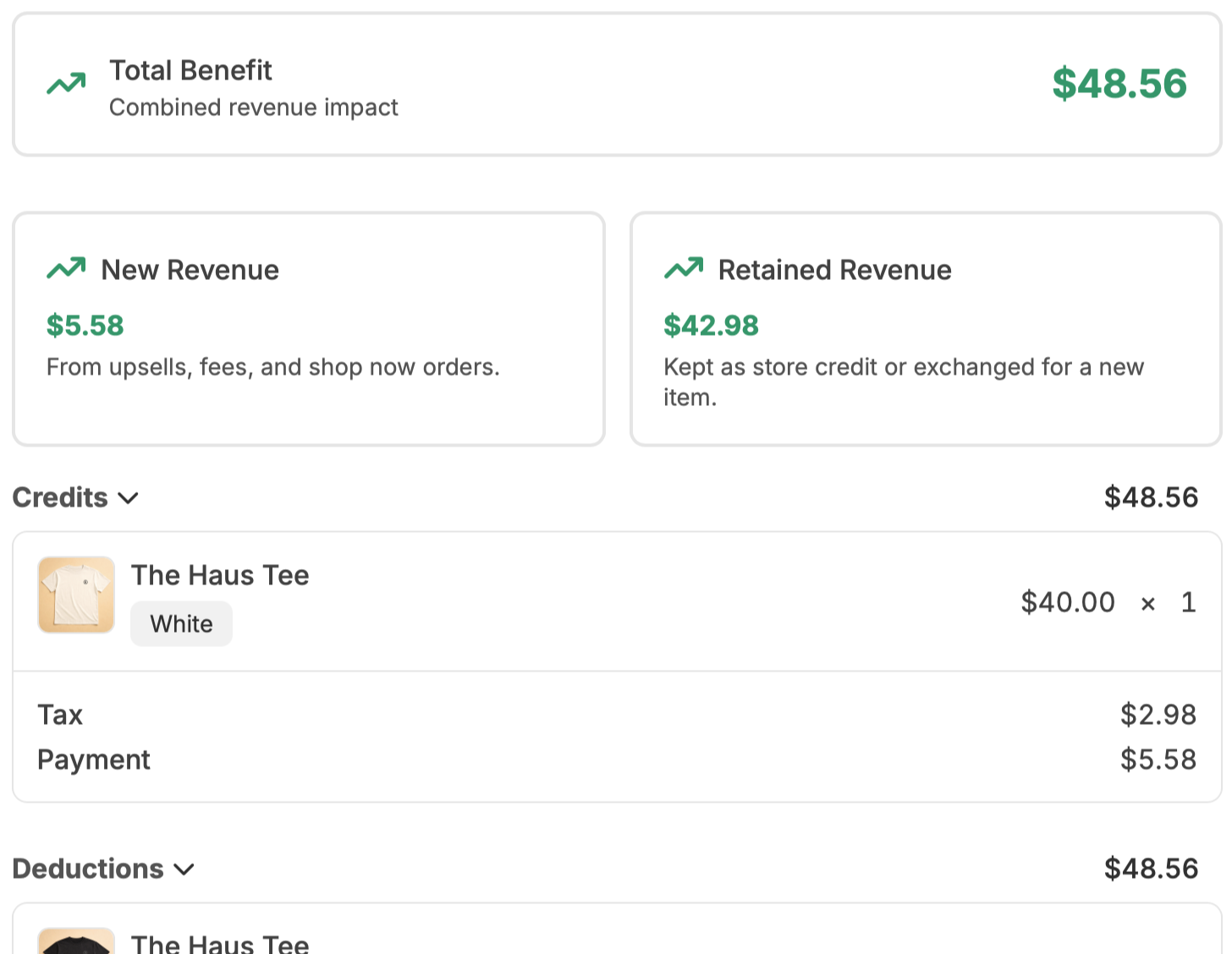
The Returns Ledger provides a financial drill-down into every exchange, credit, deduction, upsell, and downsell. Exchange program management as accounting, not intuition.
$24,830
Credits Issued
$2,410
Bonus Given
+$6,220
Upsell Captured
68%
Net Retained
Financial drill-down
Filter by time period, exchange type, product, reason, or customer segment. See which exchange paths perform best for which product categories. Track trends over time.
Bonus ROI
Identify whether bonus incentives generate positive ROI, meaning more retained revenue than bonus cost. Compare bonus spend against exchange rate lift across segments.
Upsell & downsell tracking
Revenue captured when customers exchange for higher-value items. Revenue lost on downsells. Net movement across all Advanced Exchanges and Shop Now claims.
Claim Benefit analytics
Revenue-retention and upsell reporting specifically for Shop Now claims. How much credit was used, how much additional spending was captured, and the net revenue impact per claim.
Shopify accounting: Corso creates exchange orders using the Shopify Returns API. Exchange transactions appear in standard Shopify reporting (new items, applied credit, price difference, and discount code all recorded natively). No reconciliation needed. The Returns Ledger adds the retention and incentive layer on top.
Next Steps
Continue exploring.
Automation & Workflows
Rules engine, cookbook recipes, claim processing workspace, eligibility controls
Self-Service Portal
Branded portal, customization, shipping and label options, gift returns
Fraud & Risk Protection
Claim Risk scoring, serial returner detection, cross-claim visibility
Returns & Exchanges
Full overview of Corso's returns and exchange capabilities
See exchanges tailored just for your store.
Book a demo to walk through Shop Now, Instant Exchanges, and the incentive layer with your products, your pricing, and your customer segments. Protection revenue can fund the whole program including bonus credits, free exchange shipping, and return labels.