

Background
A decades-old commitment
Tupperware Brand has sold a lifetime warranty for as long as it has sold food storage. This is a promise made across seventy-eight countries, three sales channels, and several decades of products, most of which no longer exist in any catalog.
In late 2024 the company was sold to new owners. Since then it has been rebuilding as a profitable business on a fraction of its former resources, which meant every system it depended on came up for review at once.
Every system and every process has to be questioned, worked through, new technology applied, and then operationalized in a short amount of time with very few resources. Jason Carrigan, Global E-commerce, Tupperware Brand
Because of the operational challenges and impact, the warranty was the first system Jason took on.
The challenge
Surveying the operational challenges
No visibility. The existing program ran on two separate custom-built tools stitched together with integration work, and produced no analytics at all. Tupperware Brand could honor claims but could not answer basic questions about them. Nobody knew what the program cost, which items drove it, or whether the same customers kept coming back.
Volume against a cost center. Tupperware Brand’s independent consultants use the lifetime warranty as a selling tool, offering to help customers redeem broken product for credit toward something new. Claims arrive in the thousands every month, creating a real expense to consider.
We don’t love that it’s a marketing tool, because it incurs warranty expense. But it is.
Products that live outside the online store. Most warranty solutions struggle here. The products in Shopify are the products currently for sale — they are not the warrantable products. Someone claiming a single bowl from a thirty-six-piece set bought four decades ago is claiming an item that appears in no currently available order record, under a SKU that may have been discontinued, in a color that ran for one season. Roughly two thousand warrantable items sat in a spreadsheet.
The evaluation
Why Tupperware chose Corso
Jason came to Corso through a referral from Tupperware Brand’s Shopify merchant success manager, then ran the evaluation himself: seven vendors in the post-purchase category, two or three meetings with each, and an in-depth analysis of all of them.
Tupperware Brand does not take many returns, so returns capability was important, but not the most important capability. Warranty management is a core operating function of the business, so that is what he graded on.
Corso was the leader by a long shot in terms of warranties.
The diligence was warranted, because a post-purchase platform is unusually hard to reverse. There are always customers mid-claim when you switch, which means the old system has to be wound down while the new one spins up. Other switching costs stack up as well.
The deciding factor, though, was not a feature.
The real value of any of these apps, for any size company, is the team that’s supporting behind the scenes.
The build
What Tupperware Brand built
Registering products that were never in Shopify
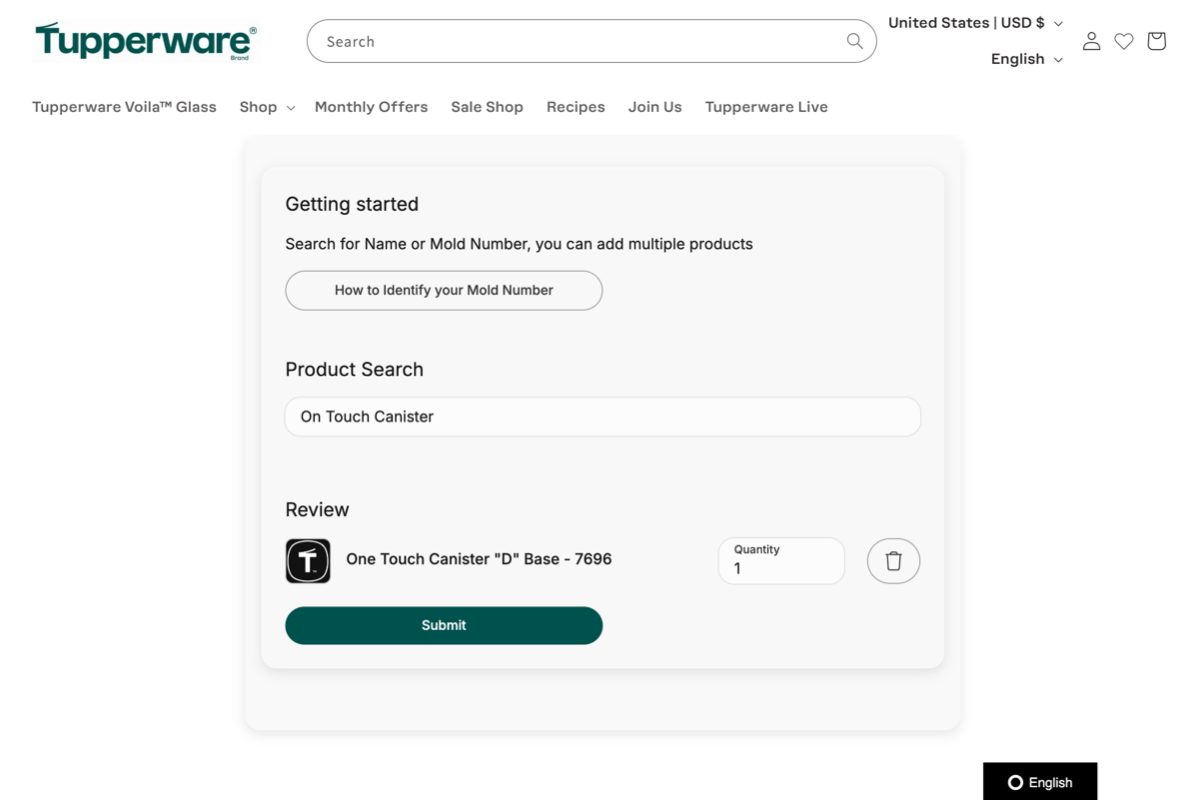
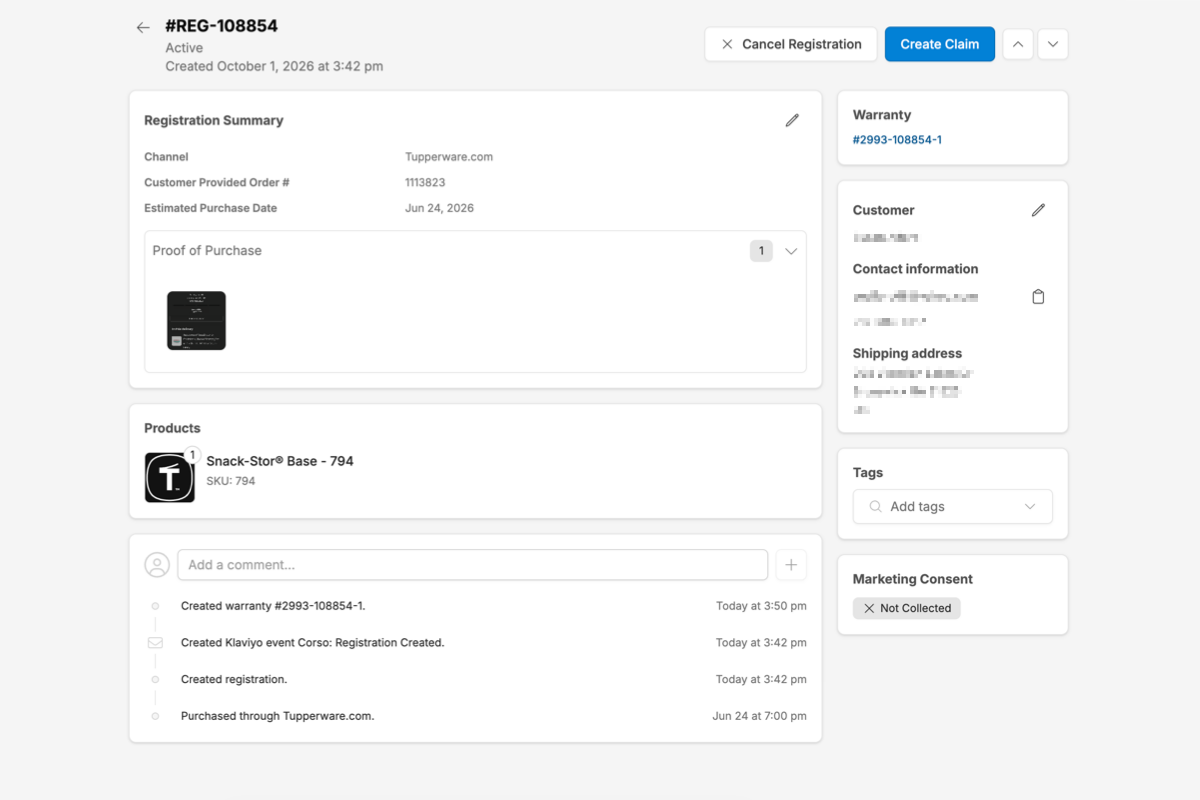
Corso holds Tupperware Brand’s full warrantable parts list — roughly two thousand items, each flagged for whether it is still supported — as a searchable registry independent of the Shopify product catalog. A customer finds the single bowl rather than the set it arrived in, but a thirty-six-piece purchase ends up as a one-item claim.
Because there is no ongoing reason to register a plastic bowl the way you would register a television, registration happens at the moment of the claim rather than the moment of purchase.
There’s no software updates of your plastic bowl.
Auto-approving the claims that should be auto-approved
Every claim is scored for fraud signals and against customer-level thresholds. Depending on the product being claimed, Corso routes the request to an appropriate discount. While most Tupperware Brand's customers file one claim in their lifetime and present almost no risk, all claims are run through Corso's fraud detection. The ones that pass close on their own.
Just as important, customers who are flagged for review are told so — which removed an entire class of support contact.
“If they were flagged for fraud or flagged for manual review, they knew it. So they weren’t calling in asking what’s up with my warranty.”
Support tickets fell and satisfaction with the warranty experience rose, for the same reason: people got an answer immediately instead of waiting on a queue.
Resolving in dollars, not percentages
Tupperware Brand resolves warranty claims with a discount code per item — not a percentage discount, and not an exchange.
Jason built a working prototype himself using Shopify Flow connectors and brought it to the Corso team, who built native support for it into the platform. Every Corso merchant now has it.
Keeping everything Shopify-native
Warranty credits are issued as Shopify discount codes. Notifications run through Klaviyo off Corso’s registration and claim events. Claims surface in Gorgias, where the support team already works. There is no custom integration layer anywhere in the stack.
That decision produced the reporting Tupperware Brand had never had. Because resolutions live in Shopify, the cost of the program, the highest-claim items and any residual fraud patterns are all answerable in Shopify analytics directly. Additional post-purchase specific data points not tied to Shopify data are available through custom Corso reporting.
We have facts around our warranty program that we never had before.
