

Background
From nothing, to a spreadsheet
Spencer Brinson has run Cotopaxi’s warranty team for the last two years. When he arrived, there was no warranty system to speak of. The first fix was the one most growing brands reach for: a shared Google Sheet.
They had nothing at first. Then they developed a Google spreadsheet where it was a manual tracking system. Spencer Brinson, Warranty & Repairs Manager, Cotopaxi
The spreadsheet worked in the sense that claims got logged. It did not work in the sense that anyone could run a team on it.
The challenge
Surveying the operational challenges
A spreadsheet is a second job. A manual tracker is only as good as the last person who updated it. Keeping it accurate fell to Spencer, on top of actually managing the team.
It was really hard to manage. I took a massive amount of my own time, as the manager of it, to make sure it was updated and functioning properly.
Double entry, every day. Agents worked customer conversations in Kustomer, then re-typed the same details into the tracker. One extra form is a small thing. One extra form on every ticket, all day, every day, is not.
They’re spending their time inputting information into another form. That just wears on them when it’s day in and day out.
A swivel chair to Shopify. Approving a claim was not the end of it. To actually send a customer their replacement, an agent had to leave the conversation, open Shopify, and place the order by hand.
Chasing the details. Every claim started with a lookup in the spreadsheet, and many started with missing information. Agents went back and forth with customers over multiple messages to collect the product, the order, and the issue details needed to make a call.
Customers who go quiet. Warranty conversations rarely close in one reply. A customer sends half the details, disappears for a week, and comes back. Every time, the agent had to read the entire history again to figure out where things stood.
Customers aren’t always easy, as we know, if you work in the warranty department or customer support. Sometimes they don’t get back to you in a timely manner.
The requirement
Meet the team where it already works
Cotopaxi’s support team lives in Kustomer. Adding another standalone tool would have just moved the double entry somewhere new. What the team needed was warranty data, claim actions, and order history sitting inside the conversation they already had open.
That is what Corso’s Kustomer integration is built to do.
One of the best things about this integration: it’s literally a one-stop shop.
The build
What Cotopaxi built
Collecting everything at submission
Cotopaxi’s warranty and registration flows in Corso gather what the team needs up front, when the customer files the claim. By the time a claim reaches an agent, the product, order, and issue details are already attached. The multi-message thread to piece a claim together is gone, and so is the spreadsheet lookup.
Corso, inside every Kustomer conversation
The Corso Insights panel sits right in the agent’s Kustomer view. It shows the customer’s name, email, and full Shopify order history, with search and filters, plus every claim tied to each order. One click opens a claim’s full details without leaving Kustomer.
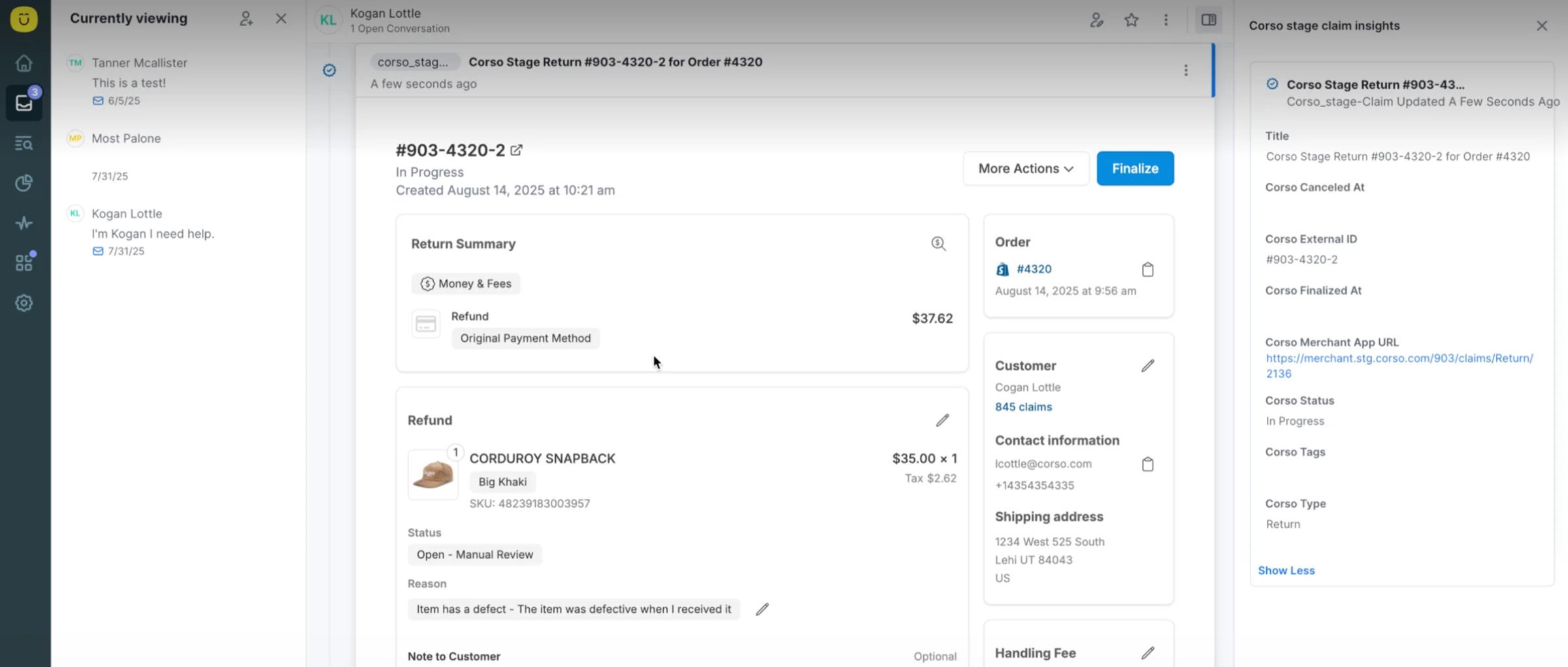
Creating claims and orders without leaving the ticket
Agents create warranty claims straight from the customer’s Kustomer profile: pick the product, choose the reason, set the resolution, and confirm the customer’s details. From there they can update the resolution, finalize the claim, and change tags and statuses without ever opening Corso Admin or Shopify.
We used to have to go to Shopify to place the order. Now they can generate the order directly from customers.
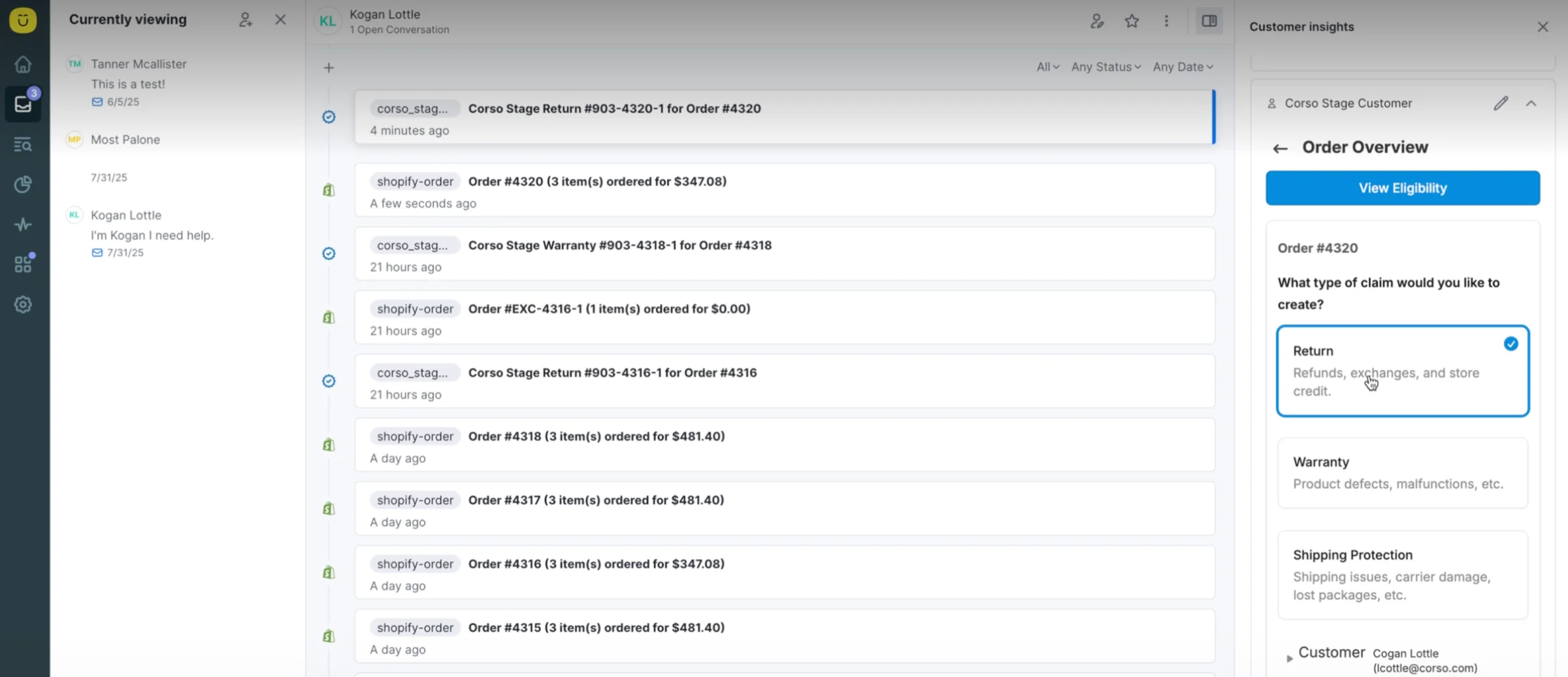
Picking up exactly where the customer left off
Every Corso claim event lands on the customer’s Kustomer timeline next to their orders and messages. When a customer goes quiet and comes back a week later, the agent does not have to reconstruct the story. The status, the resolution, and the next step are already on screen.
“Being able to go back and find all the information without having to read back a history. They know exactly what to do just by a quick little overview on the Corso tab.”
The time saved is not just in the clicks. It is in the minutes agents used to spend re-reading threads before they could even respond.
One source of truth, kept in sync
Changes made in Corso flow into Kustomer in near real time, including creation, updates, and finalization. Claim statuses and tags stay current on both sides, so the team can segment customers by claim status, tag, or finalization date. The Google Sheet is retired. Nobody has to keep it up to date anymore, least of all the manager.
We’re managing the queue better than we ever have.